
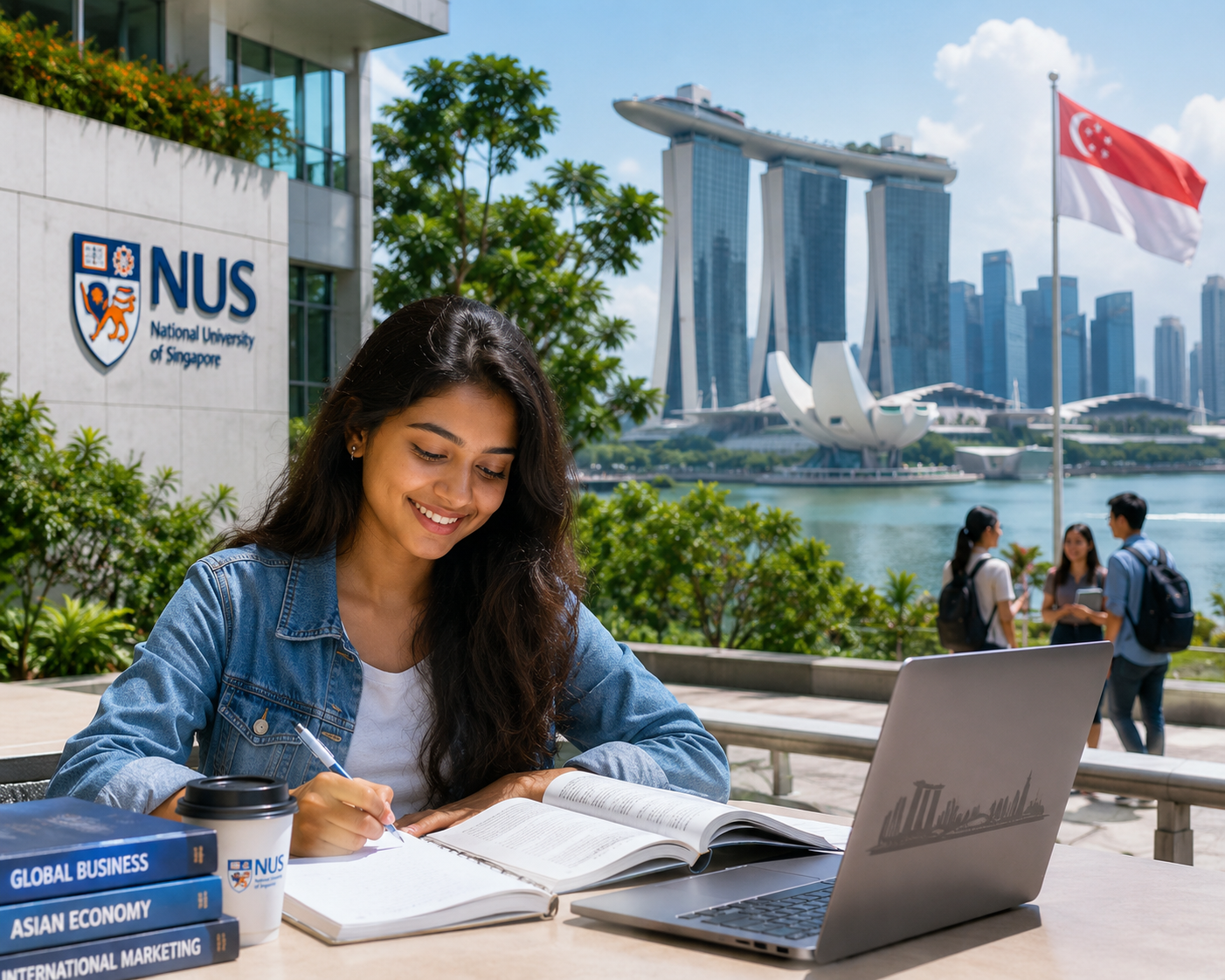
Study in Singapore for Indian Students
Singapore combines world-class universities with one of Asia's leading financial and technology hubs. Indian students benefit from a safe, highly connected city-state, strong employer presence, and globally respected qualifications from institutions like NUS and NTU.
Why Study in Singapore?
Singapore offers Indian students access to some of Asia's most highly regarded universities within a safe, efficient, and highly connected city-state. As a major regional hub for finance, technology, and logistics, Singapore provides strong exposure to multinational employers and internship opportunities. Students should note that Singapore does not offer a dedicated post-study work visa; employment after graduation generally requires securing a job offer and employer-sponsored work pass. Popular fields include Business, Engineering, Computer Science, and Finance, with two main intakes in August and January.
Singapore Study Abroad Snapshot
| Category | Details |
|---|---|
| Country | Singapore |
| Capital | Singapore (city-state) |
| Currency | Singapore Dollar (SGD) |
| Language | English (official), Mandarin, Malay, Tamil |
| Popular Student Areas | Kent Ridge, Jurong, Novena, one-north |
| Popular Courses | Business, Engineering, Computer Science, Finance |
| Major Intakes | August (main), January (secondary) |
| Study Visa | Student's Pass |
| Part-Time Work | Up to 16 hours/week during term at approved institutions |
| Post-Study Options | No dedicated post-study visa; employment requires employer-sponsored work pass |
| Typical Tuition Range | SGD 20,000–40,000 per year for international students (varies by university and program) |
| Typical Living Cost | SGD 1,200–2,200 per month |
Why Study in Singapore?
World-Class Universities
Home to NUS and NTU, both globally recognised for research and academic excellence.
Global Business Hub
A leading centre for finance, technology, and logistics, offering strong internship and networking opportunities.
Safety and Cleanliness
Consistently ranked among the safest and cleanest cities globally, appealing to international students and parents.
Regional Connectivity
A major aviation hub with easy access to the rest of Southeast Asia and relatively short flights to India.
English-Medium Education
English is the primary language of instruction, easing academic and daily life adjustment.
Multinational Employer Presence
Numerous global companies have regional headquarters in Singapore, supporting internship and networking access.
Understanding the Singapore Education System
Singapore's higher education system includes autonomous public universities and a growing number of private institutions, many with strong ties to industry.
- Undergraduate (Bachelor's): Typically 3–4 years, depending on the field of study, with strong emphasis on research and industry exposure.
- Postgraduate (Master's): Usually 1–2 years, available as coursework or research-based programs.
- Doctoral (PhD): Generally 4–5 years, research-focused, often funded through scholarships and stipends at public universities.
- Diploma Programs: Offered at polytechnics, providing practical, industry-oriented pathways, sometimes leading into degree programs.
Popular Courses to Study in Singapore
Business and Management
Strong ties to Singapore's status as a global financial and business hub.
Engineering
Well-regarded programs connected to Singapore's advanced manufacturing and technology sectors.
Computer Science
Strong demand aligned with Singapore's push to become a regional technology and innovation hub.
Finance
Reflects Singapore's role as one of Asia's leading financial centres.
Data Science and Analytics
Growing field with strong applications across finance, logistics, and technology sectors.
Maritime and Logistics Management
Reflects Singapore's position as one of the world's busiest shipping and logistics hubs.
Top Universities in Singapore
National University of Singapore (NUS)
One of Asia's most highly regarded universities, known for a broad range of research-intensive programs.
Visit Official WebsiteNanyang Technological University (NTU)
Known for engineering, technology, and business programs with strong research output.
Visit Official WebsiteSingapore Management University (SMU)
Known for business, law, and social sciences with a city-campus, seminar-style teaching approach.
Visit Official WebsiteSingapore University of Technology and Design (SUTD)
Known for design-centric engineering and technology programs.
Visit Official WebsiteSingapore Institute of Technology (SIT)
Known for applied, industry-focused degree programs developed with overseas university partners.
Visit Official WebsiteBest Student Cities in Singapore
Kent Ridge (NUS Campus Area) High
- Why students choose it
- Home to Singapore's largest university, offering extensive research and library resources.
- Popular industries
- Education, research, technology
- Lifestyle
- Academic, green campus setting
Jurong / one-north Moderate–High
- Why students choose it
- Growing innovation and business park district close to NTU and technology employers.
- Popular industries
- Technology, R&D, biomedical sciences
- Lifestyle
- Modern, business-oriented
Novena / Central Singapore High
- Why students choose it
- Centrally located with strong access to internships and corporate employers.
- Popular industries
- Finance, healthcare, business
- Lifestyle
- Urban, highly connected
Tuition Fees in Singapore
| Study Level | Indicative Annual Tuition | Notes |
|---|---|---|
| Undergraduate | SGD 20,000 – 35,000 | International student rates; subsidised rates may be available with post-study work bond obligations. |
| Postgraduate (Master's) | SGD 25,000 – 45,000 | Business and finance programs are often at the higher end. |
| PhD | Often funded | Public university PhD programs frequently include scholarships and stipends for eligible candidates. |
Cost of Living for International Students
| Expense Category | Indicative Monthly Range |
|---|---|
| Accommodation | SGD 700 – 1,500 |
| Food | SGD 300 – 600 |
| Transportation | SGD 80 – 150 |
| Utilities | SGD 60 – 120 |
| Internet | SGD 30 – 50 |
| Personal Expenses | SGD 150 – 300 |
| Health Insurance | Mandatory; typically arranged through the university |
Student Accommodation in Singapore
- University Halls of Residence: Available at public universities, though places can be competitive and often allocated by point systems.
- Private Student Accommodation: Purpose-built housing near campuses, offering studio or shared rooms.
- Shared Private Rentals: An option for students who prefer more independence, though Singapore's rental market can be costly.
On-campus halls are the most cost-effective option where available, while private accommodation offers more flexibility at a higher cost, reflecting Singapore's generally high cost of living.
Eligibility Requirements to Study in Singapore
- Completed secondary or undergraduate education relevant to the intended program
- Minimum academic performance as specified by the chosen university
- English language proficiency scores (IELTS, TOEFL, PTE)
- Valid passport
- Offer of admission from a recognised Singapore institution
- Proof of financial capability to cover tuition and living costs
IELTS, PTE and TOEFL Requirements
| Test | Typical Requirement | Important Notes |
|---|---|---|
| IELTS | ~6.0 – 7.0 overall | Requirements vary by university and program; competitive programs may require higher scores. |
| TOEFL iBT | ~85 – 100+ | Accepted at most Singapore universities. |
| PTE Academic | ~58 – 65+ | Accepted at a growing number of institutions. |
How to Apply to Study in Singapore
Profile Assessment
Evaluate academic background, goals, and budget to identify suitable programs.
Course Selection
Shortlist programs aligned with career goals and eligibility.
University Shortlisting
Build a balanced list of ambitious, moderate, and safe university options.
Document Preparation
Prepare transcripts, personal statement, references, and test scores.
Application Submission
Submit applications directly through each university's admissions portal.
Offer Letter
Accept your offer of admission from the university.
Financial Planning
Arrange tuition funding, education loans, or scholarships as required.
Student's Pass Application
Apply for the Student's Pass through the Immigration and Checkpoints Authority (ICA).
Pre-Departure
Arrange travel, accommodation, insurance, and attend a pre-departure briefing.
Singapore Student Visa Guide
Most Indian students studying full-time in Singapore require a Student's Pass, issued by the Immigration and Checkpoints Authority (ICA).
- Visa Name: Student's Pass
- Who Needs It: International students enrolled in a full-time course at an approved Singapore institution
- Application Process: Most applications are submitted online via the Student's Pass Online (SOLAR) system, typically coordinated by the institution
- Financial Requirements: Proof of funds to cover tuition and living costs, as specified by the institution and ICA
- Health Insurance: Mandatory health insurance is generally arranged through the university
- Post-Study Work: Singapore does not offer a dedicated post-study work visa; employment requires an employer-sponsored work pass such as an Employment Pass or S Pass
Learn more from Immigration and Checkpoints Authority (ICA) and the Ministry of Education, Singapore.
Documents Required for Singapore Student Visa
- Valid passport
- Offer of admission from a recognised Singapore institution
- Proof of financial funds
- Health insurance confirmation
- Academic transcripts and certificates
- English test scores (IELTS/TOEFL/PTE), where required
- Passport-size photographs meeting visa specifications
- Completed Student's Pass application (typically via SOLAR)
Singapore Student Visa Process
Study Intakes in Singapore
| Intake | Typical Application Period | Suitable Programs |
|---|---|---|
| August (Main) | Applications generally open several months in advance | Widest range of undergraduate and postgraduate programs |
| January (Secondary) | Applications typically open mid-year | Available at many institutions for select programs |
Scholarships to Study in Singapore
- Singapore International Graduate Award (SINGA): Government-linked scholarship for PhD candidates in science and engineering, subject to eligibility criteria.
- University Merit Scholarships: Awarded by NUS, NTU, SMU, and other institutions based on academic achievement.
- ASEAN and Tuition Grant Schemes: Some subsidised tuition options are available but often come with a post-study work bond obligation — review terms carefully.
Explore more on our scholarships page.
Can International Students Work Part-Time in Singapore?
International students on a Student's Pass may work part-time under specific conditions set by the Ministry of Manpower.
- Eligibility: Full-time enrollment at an approved institution with a valid Student's Pass
- Hours: Generally up to 16 hours/week during term-time, where permitted
- Restrictions: Work rights and eligible institutions are determined by current government policy
- Recommendation: Confirm current part-time work rules directly with your institution before relying on part-time income
Internship Opportunities in Singapore
- University Internship Programs: Many programs at NUS, NTU, and SMU include structured internship components with multinational companies.
- Industry Partnerships: Singapore's concentration of regional headquarters supports strong internship access across finance, tech, and logistics sectors.
Post-Study Work Opportunities in Singapore
Singapore does not offer a dedicated post-study work visa comparable to some other destinations. Graduates seeking to remain and work in Singapore generally need to secure a job offer and have their employer apply for a work pass, such as an Employment Pass or S Pass, subject to current eligibility criteria and quotas.
Career Opportunities After Studying in Singapore
- Finance and Banking
- Technology and Software Development
- Logistics and Supply Chain Management
- Consulting
- Biomedical Sciences
- Data Analytics
Career outcomes depend on individual qualifications, industry demand, and current employment and immigration regulations. Outcomes are not guaranteed.
Permanent Residency and Long-Term Opportunities
Graduates who secure employer-sponsored work passes and build a sustained career in Singapore may, over time, become eligible to apply for Permanent Residency through Singapore's Immigration and Checkpoints Authority, subject to points-based and discretionary eligibility criteria that can change.
Student Life in Singapore
Singapore's universities are known for their modern campuses, strong emphasis on research, and vibrant student life supported by numerous clubs, cultural groups, and sports facilities. A large and active Indian student community exists, particularly around NUS and NTU, supported by cultural associations and festivals throughout the year.
Is Singapore Good for Indian Students?
Singapore has a significant and well-established Indian community, particularly in areas like Little India, offering easy access to Indian food, festivals, and religious institutions. English as the primary language of instruction and daily communication eases the transition considerably. The tropical climate is warm and humid year-round, and Singapore's small size makes commuting and daily logistics generally straightforward.
Healthcare, Transportation & Climate
Healthcare
International students are generally required to have health insurance, often arranged through the university, providing access to Singapore's well-regarded healthcare system.
Transportation
Singapore has an extensive and efficient MRT and bus network, making it easy to travel across the city without a personal vehicle.
Climate
Singapore has a consistently warm, humid tropical climate year-round, with regular rainfall; lightweight clothing is suitable throughout the year.
Singapore vs Other Popular Study Destinations
| Destination | Tuition | Living Cost | Popular Courses | Study Visa | Part-Time Work | Post-Study Options | Best For |
|---|---|---|---|---|---|---|---|
| Singapore | Mod–High | High | Business, IT, Finance | Student's Pass | Up to 16 hrs/wk (eligible) | Employer-sponsored pathway | Global finance and tech hub |
| Malaysia | Low | Low–Moderate | Business, Engineering, IT | Student Pass | Limited (breaks only) | Limited; employer-sponsored | Affordable branch-campus degrees |
| UK | Mod–High | High | Business, Law, Engineering | Student Visa | Up to 20 hrs/wk (term-time) | Graduate Route | Shorter Master's programs |
| USA | High | High | CS, Business, Engineering | F-1 | Limited on-campus; CPT | OPT / STEM OPT | Research & STEM careers |
Who Should Consider Studying in Singapore?
- Students seeking a globally top-ranked education within Asia
- Applicants targeting careers with multinational finance or technology employers
- Students who value safety, cleanliness, and efficient infrastructure
- Applicants comfortable with a higher cost of living in exchange for strong career exposure
- Students who prioritize academic reputation over post-study immigration pathways
Expert Tips for Indian Students
- Apply well in advance, as NUS and NTU are highly competitive for international applicants.
- Review tuition grant and subsidised fee options carefully, as they may include a post-study work bond.
- Budget for Singapore's high cost of living, particularly accommodation.
- Research internship opportunities early, as competition for placements with multinational employers is high.
- Understand that post-study employment requires a job offer and employer-sponsored work pass.
Common Mistakes to Avoid
- Assuming Singapore offers a dedicated post-study work visa like some other countries
- Underestimating the high cost of accommodation and daily living
- Not reviewing the terms and bond obligations of subsidised tuition grant schemes
- Applying late for highly competitive programs at NUS or NTU
- Overlooking the limited and conditional nature of part-time work rights
How White Glove Overseas Education Services Can Help
- Profile Assessment
- Course Selection
- University Shortlisting
- Application Assistance
- SOP/LOR Guidance
- Scholarship Guidance
- Offer Letter Support
- Visa Guidance
- Accommodation Guidance
- Pre-Departure Support
Our counsellors help Indian students navigate every stage of the Singapore application journey. Explore Our Services
Frequently Asked Questions About Studying in Singapore
How much does it cost to study in Singapore?
Tuition typically ranges from SGD 20,000 to 40,000 per year for international students depending on the university and program, while living costs range from roughly SGD 1,200 to 2,200 per month.
Which are the best universities to study in Singapore?
Singapore is home to NUS and NTU, both globally regarded, along with SMU, SUTD, and SIT, each with distinct strengths. Students should evaluate program fit and career goals.
What are the most popular courses for Indian students in Singapore?
Business, Engineering, Computer Science, and Finance are among the most popular, reflecting Singapore's role as a regional finance and technology hub.
What IELTS score is required to study in Singapore?
Requirements vary by university, but many programs require an overall IELTS score between 6.0 and 7.0.
Is PTE accepted for Singapore university admissions?
Yes, PTE Academic is accepted at a growing number of Singapore universities, though requirements vary — confirm with your chosen institution.
What type of visa do I need to study in Singapore?
Most international students require a Student's Pass, issued by the Immigration and Checkpoints Authority (ICA), typically applied for through the SOLAR online system.
What documents are required for the Singapore student visa?
Key documents include a valid passport, offer of admission, proof of funds, health insurance confirmation, academic transcripts, and English test scores where required.
What are the intakes available in Singapore?
The main intake is August, with a secondary intake in January available at many institutions.
Are scholarships available for Indian students in Singapore?
Yes, including the Singapore International Graduate Award (SINGA) for PhD candidates and university-specific merit scholarships.
Can international students work part-time while studying in Singapore?
International students on a Student's Pass may work up to 16 hours per week during term-time under specific conditions — confirm current rules with your institution.
What is the accommodation cost in Singapore for students?
Accommodation typically ranges from SGD 700 to 1,500 per month depending on housing type, reflecting Singapore's generally high cost of living.
What is student life like in Singapore?
Singapore student life includes modern campuses, active clubs and societies, and a large, well-established Indian student community, particularly around NUS and NTU.
Does Singapore offer a post-study work visa?
No, Singapore does not offer a dedicated post-study work visa. Graduates generally need a job offer and an employer-sponsored work pass, such as an Employment Pass or S Pass, to remain and work.
Does studying in Singapore lead to permanent residency?
Not automatically. Graduates who secure sustained employer-sponsored employment may, over time, become eligible to apply for Permanent Residency, subject to current eligibility criteria.
What is the application process for studying in Singapore?
The process includes profile assessment, course and university shortlisting, document preparation, application submission, offer letter, financial planning, and Student's Pass processing via SOLAR.
Ready to Start Your Singapore Study Journey?
Get personalized guidance from White Glove Overseas Education Services and take the next confident step toward studying in Singapore.
Important Information
Visa rules, tuition fees, scholarship availability, work rights, financial requirements and immigration policies can change. Students should verify the latest requirements with the relevant university and official government or immigration authority before applying.
The information provided by White Glove Overseas Education Services is intended for general educational guidance and does not guarantee admission, visa approval, employment, scholarships or permanent residency.