
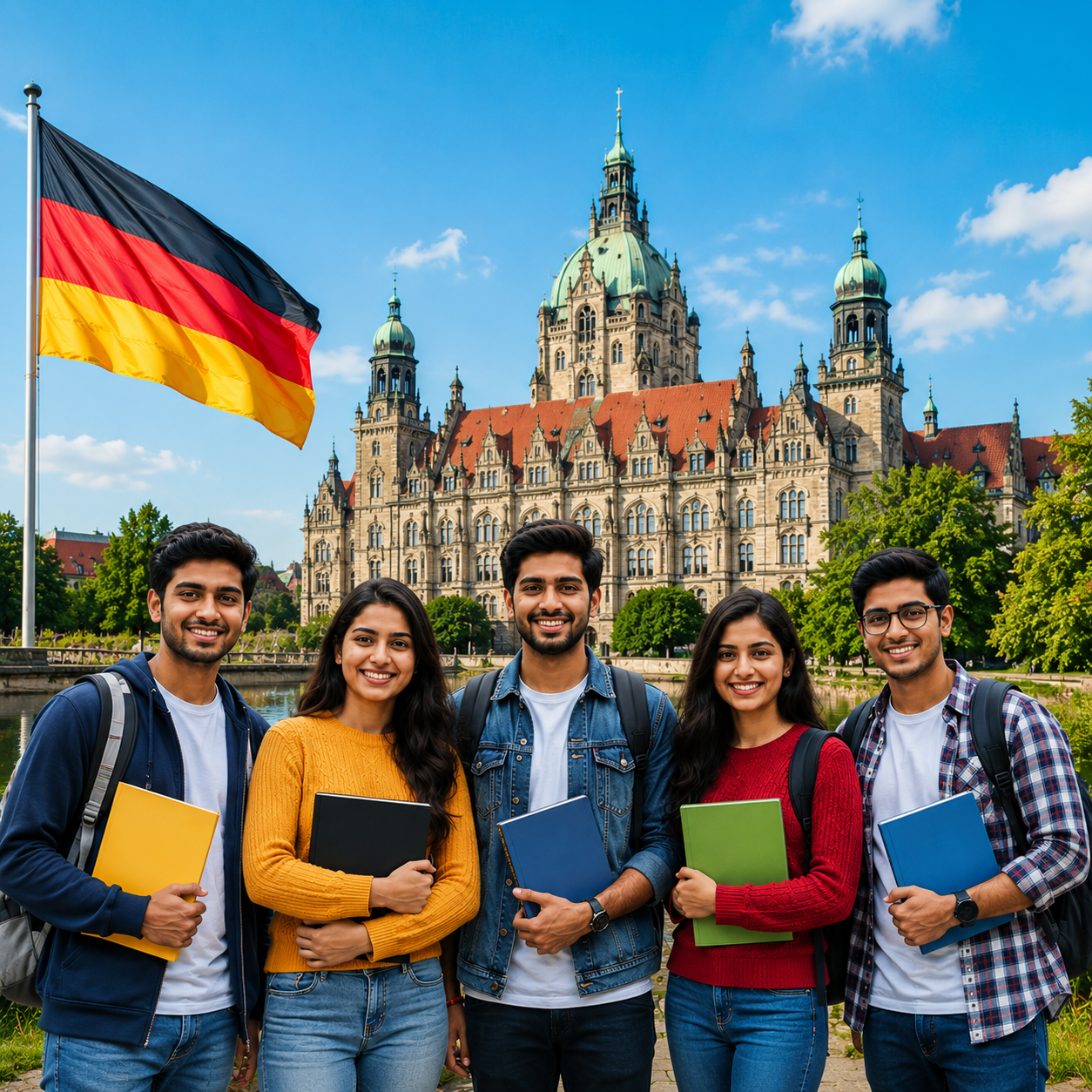
Study in Germany for Indian Students
Germany offers Indian students world-class engineering and technology education, largely tuition-free at public universities, alongside a strong industrial economy and an 18-month post-study job-seeking period. It remains one of the most cost-effective high-quality study destinations in Europe.
Why Study in Germany?
Germany offers Indian students access to globally respected engineering and technology programs, largely free or low-cost tuition at public universities, and a strong, export-driven economy with high demand for skilled graduates. Most public universities charge only a nominal semester contribution rather than tuition fees, though some states and specialised programs do charge fees. Students benefit from an 18-month post-study residence permit to search for qualified employment. Popular fields include Mechanical Engineering, Computer Science, Electrical Engineering, and Automotive Engineering, with two main intakes in October (Winter) and April (Summer).
Germany Study Abroad Snapshot
| Category | Details |
|---|---|
| Country | Germany |
| Capital | Berlin |
| Currency | Euro (EUR) |
| Language | German (many Master's programs taught in English) |
| Popular Student Cities | Munich, Berlin, Frankfurt, Stuttgart, Hamburg, Aachen |
| Popular Courses | Mechanical Engineering, Computer Science, Electrical Engineering, Automotive Engineering |
| Major Intakes | October / Winter semester (main), April / Summer semester (secondary) |
| Study Visa | National (D) Visa for study purposes / residence permit |
| Part-Time Work | 120 full days or 240 half days per year |
| Post-Study Options | 18-month residence permit to search for qualified employment |
| Typical Tuition Range | €0–€350/semester at most public universities; €10,000–€20,000/year at private institutions |
| Typical Living Cost | €850–€1,200 per month, including a blocked account requirement |
Why Study in Germany?
Low-Cost, High-Quality Education
Most public universities charge little to no tuition, making Germany one of the most affordable high-quality destinations.
Engineering and Technology Strength
Home to a strong industrial base, with close ties between universities and major engineering employers.
18-Month Job-Seeking Visa
Graduates can stay in Germany for up to 18 months to search for qualified employment after their studies.
Central European Location
Germany's location offers easy access to travel and career opportunities across the European Union.
Strong Economy
A large, export-driven economy provides consistent demand for skilled graduates across engineering and technology sectors.
Research-Intensive Universities
Technical universities in particular are known for strong applied research and industry collaboration.
Understanding the Germany Education System
German higher education includes research universities (Universitäten) and universities of applied sciences (Fachhochschulen), both offering internationally recognised qualifications.
- Undergraduate (Bachelor's): Typically 3–4 years; most Bachelor's programs are taught in German, requiring German language proficiency.
- Postgraduate (Master's): Usually 2 years; many programs, especially in engineering and technology, are taught fully in English.
- Doctoral (PhD): Generally 3–5 years, often structured around independent research with a supervising professor.
- Universities of Applied Sciences: Focus on practical, industry-oriented education, often including mandatory internship semesters.
Popular Courses to Study in Germany
Mechanical Engineering
A traditional strength of German education, closely tied to the country's automotive and manufacturing industries.
Computer Science
Strong programs with close ties to Germany's growing technology and software sector.
Electrical Engineering
Well-regarded programs connected to Germany's electronics and renewable energy industries.
Automotive Engineering
Reflects Germany's global leadership in the automotive industry, home to major manufacturers.
Data Science and Analytics
Growing field with strong applications across Germany's engineering and finance sectors.
Renewable Energy Engineering
Reflects Germany's leadership in energy transition and sustainability initiatives.
International Business
Popular among students seeking English-taught business programs with a European focus.
Biotechnology
Strong research infrastructure supports biotechnology and life sciences programs.
Top Universities in Germany
Technical University of Munich
Known for engineering, computer science, and strong industry partnerships.
Visit Official WebsiteLudwig Maximilian University of Munich
A research-intensive university known for sciences, medicine, and humanities.
Visit Official WebsiteRWTH Aachen University
Known for engineering and technology programs with strong industry links.
Visit Official WebsiteHumboldt University of Berlin
Known for humanities, social sciences, and natural sciences in the capital.
Visit Official WebsiteHeidelberg University
One of Germany's oldest universities, known for medicine and natural sciences.
Visit Official WebsiteKarlsruhe Institute of Technology (KIT)
Known for engineering and technology research with strong industry collaboration.
Visit Official WebsiteTechnical University of Berlin
Known for engineering, computer science, and architecture programs.
Visit Official WebsiteUniversity of Freiburg
Known for environmental sciences, medicine, and a strong research culture.
Visit Official WebsiteBest Student Cities in Germany
Munich High
- Why students choose it
- Home to major technology and automotive employers with strong graduate job prospects.
- Popular industries
- Automotive, technology, finance
- Lifestyle
- Prosperous, well-organised
Berlin Moderate
- Why students choose it
- Germany's capital with a growing startup and technology scene and lower costs than Munich.
- Popular industries
- Technology, startups, creative industries
- Lifestyle
- Diverse, dynamic
Frankfurt Moderate–High
- Why students choose it
- Germany's financial capital, home to major banks and international corporations.
- Popular industries
- Finance, banking, logistics
- Lifestyle
- Cosmopolitan, business-focused
Stuttgart Moderate
- Why students choose it
- Home to major automotive manufacturers and strong engineering employers.
- Popular industries
- Automotive, engineering, manufacturing
- Lifestyle
- Industrial, well-connected
Aachen Moderate
- Why students choose it
- A compact university city near the Belgian and Dutch borders, known for engineering education.
- Popular industries
- Engineering, technology, research
- Lifestyle
- Academic, historic
Tuition Fees in Germany
| Study Level | Indicative Annual Tuition | Notes |
|---|---|---|
| Public University (Bachelor's/Master's) | €0 – €350/semester | Most public universities charge only a semester contribution; some states and specialised programs may charge tuition. |
| Private University | €10,000 – €20,000/year | Private institutions typically charge tuition comparable to other Western destinations. |
| PhD | Often minimal/no tuition | Doctoral study is generally low-cost, with funding often available through research positions. |
Cost of Living for International Students
| Expense Category | Indicative Monthly Range |
|---|---|
| Accommodation | €300 – €600 |
| Food | €200 – €300 |
| Transportation | €30 – €80 (often discounted via semester ticket) |
| Utilities | €100 – €200 (varies with housing type) |
| Internet | €20 – €35 |
| Personal Expenses | €100 – €200 |
| Blocked Account Requirement | Approx. €11,000–€12,000/year (proof of funds; exact figure set annually by German authorities) |
Student Accommodation in Germany
- Student Dormitories (Studentenwohnheim): Affordable and popular, managed by local student services organisations (Studentenwerk); demand often exceeds supply.
- Shared Flats (WG): A common and cost-effective option, involving shared living space with other students.
- Private Apartments: Offer more independence but are typically more expensive, especially in cities like Munich.
Student dormitories are the most affordable option but have limited availability, so early application is strongly recommended, particularly in high-demand cities.
Eligibility Requirements to Study in Germany
- Completed secondary or undergraduate education relevant to the intended program
- Minimum academic performance as specified by the chosen university
- German language proficiency for German-taught programs (TestDaF/DSH), or English proficiency for English-taught programs
- Valid passport
- Recognition of prior qualifications through uni-assist, where applicable
- Proof of financial capability via a blocked account or approved alternative
- Subject-specific prerequisites for certain courses
IELTS, PTE and TOEFL Requirements
| Test | Typical Requirement | Important Notes |
|---|---|---|
| IELTS | ~6.0 – 7.0 overall | Required for most English-taught Master's programs. |
| TOEFL iBT | ~80 – 100+ | Accepted at many German universities for English-taught programs. |
| PTE Academic | ~55 – 65+ | Accepted at a growing number of institutions; confirm directly. |
| TestDaF / DSH (German) | Required for German-taught programs | Necessary for Bachelor's programs and some Master's programs taught in German. |
How to Apply to Study in Germany
Profile Assessment
Evaluate academic background, goals, and budget to identify suitable programs.
Course Selection
Shortlist programs aligned with career goals, considering German- vs English-taught options.
University Shortlisting
Build a balanced list of ambitious, moderate, and safe university options.
Document Preparation
Prepare transcripts, statement of purpose, references, and test scores; use uni-assist where required.
Application Submission
Submit applications directly to universities or via uni-assist, depending on the institution.
Offer Letter
Accept your offer of admission from the university.
Blocked Account Setup
Open a blocked account and deposit the required funds for visa purposes.
Visa Preparation
Apply for the National (D) Visa using your offer letter and required documents.
Pre-Departure
Arrange travel, accommodation, health insurance, and attend a pre-departure briefing.
Germany Student Visa Guide
Most Indian students studying in Germany require a National (D) Visa for study purposes, later converted into a residence permit.
- Visa Name: National (D) Visa for Study Purposes
- Who Needs It: International students enrolled in a full degree program at a German institution
- Application Process: Receive an admission letter, set up a blocked account, arrange health insurance, and apply at the German consulate
- Financial Requirements: Proof of funds via a blocked account, currently around €11,000–€12,000 for the year (exact figure set annually)
- Health Insurance: Mandatory health insurance is required before visa approval
- Post-Study Work: Graduates may apply for an 18-month residence permit to search for qualified employment
Learn more from German Federal Foreign Office and DAAD.
Documents Required for Germany Student Visa
- Valid passport
- University admission letter
- Blocked account confirmation
- Health insurance confirmation
- Academic transcripts and certificates
- Language test scores (IELTS/TOEFL/PTE or TestDaF/DSH)
- Statement of purpose
- Passport-size photographs meeting visa specifications
Germany Student Visa Process
Study Intakes in Germany
| Intake | Typical Application Period | Suitable Programs |
|---|---|---|
| October / Winter Semester (Main) | Applications generally open several months in advance | Widest range of undergraduate and postgraduate programs |
| April / Summer Semester (Secondary) | Applications typically open in the preceding months | Available at many universities for select programs |
Scholarships to Study in Germany
- DAAD Scholarships: Offered by the German Academic Exchange Service for various degree levels and research stays, subject to eligibility criteria.
- Deutschlandstipendium: A merit-based scholarship program available at many German universities.
- University-Specific Scholarships: Some institutions offer their own scholarships or fee waivers for international students.
Explore more on our scholarships page.
Can International Students Work Part-Time in Germany?
Most student visa holders can work part-time during their studies, subject to an annual day-based limit.
- Eligibility: Enrollment in a full-time degree program at a recognised institution
- Hours: Generally limited to 120 full days or 240 half days per year
- Restrictions: Working beyond this limit generally requires approval from the Federal Employment Agency
- Typical Student Jobs: Research assistant roles, retail, hospitality, tutoring
Internship Opportunities in Germany
- Mandatory Internship Semesters: Many programs at Universities of Applied Sciences include a required internship semester integrated into the curriculum.
- Industry Partnerships: Germany's strong engineering and automotive sectors provide extensive internship opportunities for STEM students.
Post-Study Work Opportunities in Germany
Graduates of German universities can apply for an 18-month residence permit to search for employment related to their qualification. Once a qualified job offer is secured, graduates can typically transition to an EU Blue Card or a general work-related residence permit, subject to current immigration rules.
Career Opportunities After Studying in Germany
- Mechanical and Automotive Engineering
- Computer Science and Software Development
- Electrical and Electronics Engineering
- Renewable Energy
- Manufacturing and Industrial Engineering
- Research and Development
Career outcomes depend on individual qualifications, industry demand, and current employment and immigration regulations. Outcomes are not guaranteed.
Permanent Residency and Long-Term Opportunities
After securing qualified employment, graduates can generally apply for an EU Blue Card or standard work-related residence permit. Continuous residence and integration over a period of years may eventually lead to a settlement permit for those who meet current eligibility requirements, including language proficiency.
Student Life in Germany
German student life centres around Studentenwerk-supported campus services, affordable semester tickets covering public transport, and a strong culture of student clubs and sports associations. Many universities host international student offices that organise orientation programs, and Indian student associations are active in major university cities.
Is Germany Good for Indian Students?
Germany has a growing Indian student population, particularly in engineering-focused cities like Munich, Stuttgart, and Aachen, with increasing availability of Indian groceries and restaurants in larger cities. Language can be a significant factor — while many Master's programs are taught in English, daily life and part-time work often require at least basic German. Winters are cold, and students should budget for warm clothing not typically needed in most of India.
Healthcare, Transportation & Climate
Healthcare
Health insurance is mandatory for all students, either through statutory (public) or private insurance, and is required before a residence permit can be issued.
Transportation
Most universities include a semester ticket covering regional public transport, and cities have well-developed tram, bus, and train networks.
Climate
Germany has a temperate climate with cold winters, often including snow, and mild summers; warm clothing is essential for the colder months.
Germany vs Other Popular Study Destinations
| Destination | Tuition | Living Cost | Popular Courses | Study Visa | Part-Time Work | Post-Study Options | Best For |
|---|---|---|---|---|---|---|---|
| Germany | Low–Mod (public) | Moderate | Engineering, Technology | Student Visa | 120 full / 240 half days/yr | Job-seeking pathway | Low-cost, engineering focus |
| USA | High | High | CS, Business, Engineering | F-1 | Limited on-campus; CPT | OPT / STEM OPT | Research & STEM careers |
| UK | Mod–High | High | Business, Law, Engineering | Student Visa | Up to 20 hrs/wk (term-time) | Graduate Route | Shorter Master's programs |
| Canada | Moderate | Mod–High | Business, IT, Healthcare | Study Permit | Up to 20 hrs/wk (off-campus) | PGWP (where eligible) | Immigration-friendly pathways |
| Ireland | Moderate | Mod–High | Business, Tech, Pharma | Stamp 2 | Up to 20 hrs/wk (term-time) | Stay Back Option | EU tech hub access |
Who Should Consider Studying in Germany?
- Students seeking low-cost, high-quality engineering or technology education
- Applicants comfortable learning German or already meeting German language requirements
- Students targeting careers in automotive, manufacturing, or renewable energy sectors
- Applicants who value strong industry-university collaboration
- Students interested in an 18-month job-seeking window built into the visa system
Expert Tips for Indian Students
- Start learning German early, even for English-taught programs, to ease daily life and job searching.
- Apply for dormitory housing as early as possible due to high demand.
- Set up your blocked account well ahead of your visa appointment.
- Research whether your program requires uni-assist for application processing.
- Understand the difference between Universitäten and Fachhochschulen when choosing a program.
Common Mistakes to Avoid
- Assuming all programs are tuition-free without checking state and program-specific fees
- Underestimating the importance of German language skills for daily life and part-time work
- Delaying blocked account setup, which can slow down visa processing
- Not applying early enough for limited dormitory accommodation
- Overlooking the 120 full-day work limit when planning part-time income
How White Glove Overseas Education Services Can Help
- Profile Assessment
- Course Selection
- University Shortlisting
- Application Assistance
- SOP/LOR Guidance
- Scholarship Guidance
- Offer Letter Support
- Visa Guidance
- Accommodation Guidance
- Pre-Departure Support
Our counsellors help Indian students navigate every stage of the Germany application journey. Explore Our Services
Frequently Asked Questions About Studying in Germany
How much does it cost to study in Germany?
Most public universities charge only a nominal semester contribution rather than tuition, though some states and programs do charge fees, and private universities can cost €10,000–€20,000 per year. Living costs are typically €850–€1,200 per month.
Which are the best universities to study in Germany?
Germany has a strong network of research universities and Universities of Applied Sciences, particularly renowned for engineering and technology. Students should evaluate program language, location, and industry ties rather than rankings alone.
What are the most popular courses for Indian students in Germany?
Mechanical Engineering, Computer Science, Electrical Engineering, and Automotive Engineering are among the most popular, reflecting Germany's strong industrial base.
What IELTS score is required to study in Germany?
Requirements vary by program, but many English-taught Master's programs require an overall IELTS score between 6.0 and 7.0.
Is PTE accepted for German university admissions?
Yes, PTE Academic is accepted at a growing number of German universities for English-taught programs, though not universally — confirm with your chosen institution.
Do I need to know German to study in Germany?
Not necessarily for English-taught Master's programs, but German-taught Bachelor's programs require language proficiency, and daily life and part-time work are easier with at least basic German.
What type of visa do I need to study in Germany?
Most international students require a National (D) Visa for study purposes, which is later converted into a residence permit after arrival.
What documents are required for the Germany student visa?
Key documents include a valid passport, university admission letter, blocked account confirmation, health insurance, academic transcripts, and language test scores.
What is a blocked account and how much is required?
A blocked account is a designated German bank account used to prove financial capability for the visa; the required amount is set annually by German authorities and currently totals roughly €11,000–€12,000 for the year.
What are the intakes available in Germany?
The main intake is the October/Winter semester, with a secondary April/Summer semester intake available at many universities.
Are scholarships available for Indian students in Germany?
Yes, including DAAD scholarships, the Deutschlandstipendium, and university-specific awards, each with its own eligibility criteria.
Can international students work part-time while studying in Germany?
Yes, students can generally work up to 120 full days or 240 half days per year without needing separate work permit approval.
What is the accommodation cost in Germany for students?
Accommodation typically ranges from €300 to €600 per month depending on the city and housing type, with dormitories being the most affordable but limited in availability.
What is student life like in Germany?
German student life centres around affordable Studentenwerk services, semester tickets covering public transport, and active student clubs, with growing Indian student communities in major cities.
What is the 18-month job-seeking residence permit?
It allows graduates of German universities to remain in Germany for up to 18 months to search for employment related to their qualification.
Does studying in Germany lead to permanent settlement?
Not automatically. Graduates who secure qualified employment can generally apply for an EU Blue Card or work permit, which may lead to a settlement permit after a period of continuous residence for those who meet current requirements.
Ready to Start Your Germany Study Journey?
Get personalized guidance from White Glove Overseas Education Services and take the next confident step toward studying in Germany.
Important Information
Visa rules, tuition fees, scholarship availability, work rights, financial requirements and immigration policies can change. Students should verify the latest requirements with the relevant university and official government or immigration authority before applying.
The information provided by White Glove Overseas Education Services is intended for general educational guidance and does not guarantee admission, visa approval, employment, scholarships or permanent residency.