
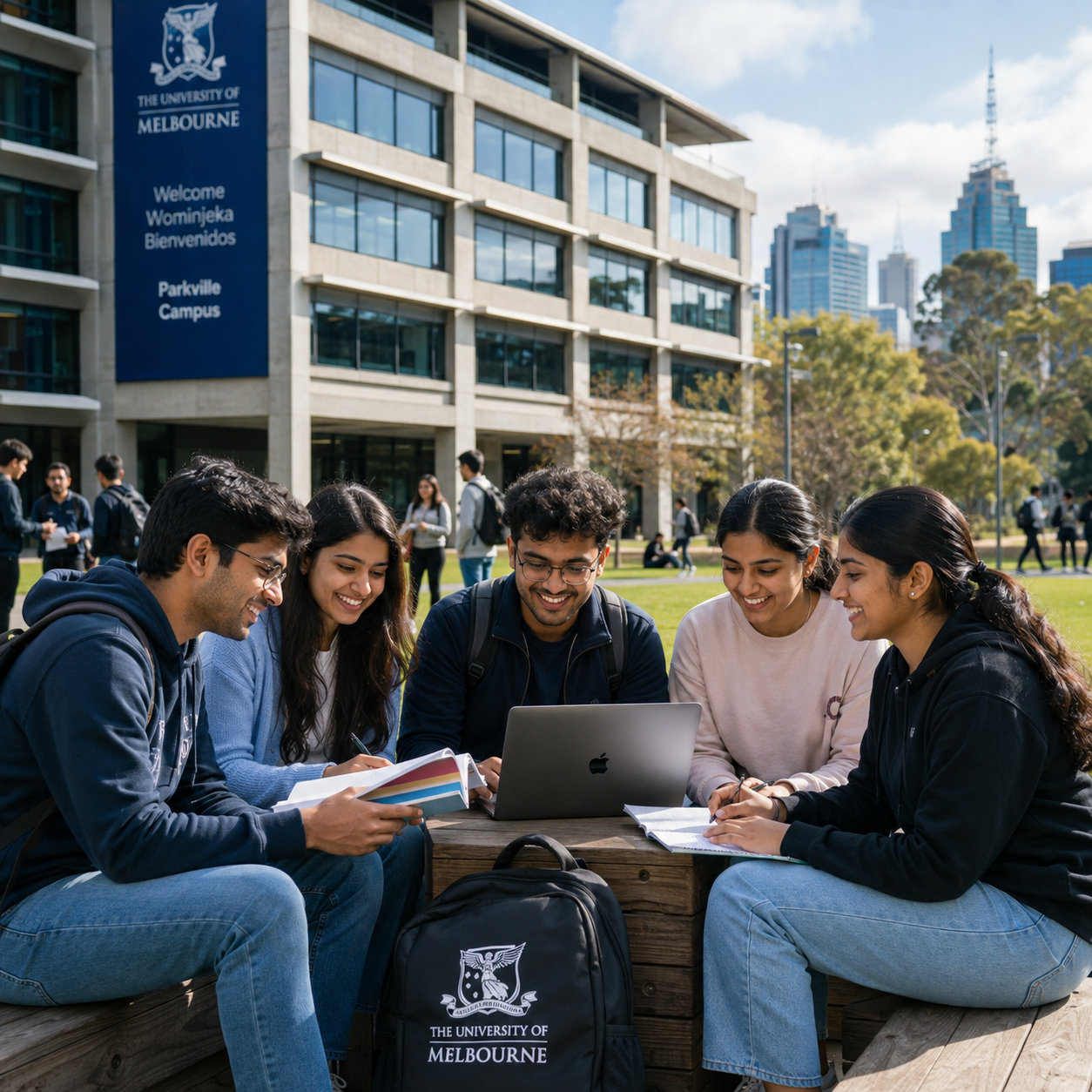
Study in Australia for Indian Students
Australia combines globally ranked universities with a relaxed, outdoor lifestyle and practical, industry-linked degrees. Indian students benefit from a well-regulated international education system, generous part-time work rights, and a Temporary Graduate visa pathway after completing their studies.
Why Study in Australia?
Australia offers Indian students a well-regulated higher education system with strong consumer protections for international students under the ESOS framework, along with practical, industry-linked degrees across business, engineering, IT, and healthcare. Students benefit from capped part-time work hours during study and a Temporary Graduate visa (subclass 485) that allows eligible graduates to live and work in Australia after their course. Popular fields include Business, Engineering, Nursing, IT, and Data Science, with two main intakes each year in February and July.
Australia Study Abroad Snapshot
| Category | Details |
|---|---|
| Country | Australia |
| Capital | Canberra |
| Currency | Australian Dollar (AUD) |
| Language | English |
| Popular Student Cities | Melbourne, Sydney, Brisbane, Adelaide, Perth, Canberra |
| Popular Courses | Business, Engineering, IT, Nursing, Data Science |
| Major Intakes | February (main), July (secondary) |
| Study Visa | Student Visa (Subclass 500) |
| Part-Time Work | Capped hours per fortnight during term (currently 48 hours/fortnight) |
| Post-Study Options | Temporary Graduate visa (Subclass 485) |
| Typical Tuition Range | AUD 20,000–45,000 per year (varies by university and program) |
| Typical Living Cost | AUD 1,400–2,500 per month (varies by city) |
Why Study in Australia?
Regulated Education System
The ESOS framework provides strong consumer protections and quality assurance for international students.
Practical, Industry-Linked Degrees
Many programs include work-integrated learning, placements, and strong ties to local industry.
Temporary Graduate Visa
Eligible graduates can apply for the subclass 485 visa to work in Australia after completing their studies.
Lifestyle and Climate
A relaxed, outdoor-oriented lifestyle with generally mild weather across major cities.
Large Indian Community
A significant and active Indian student population across major cities eases the transition.
Skilled Migration Pathways
Certain qualifications align with occupations on skilled migration lists, offering longer-term pathways for eligible graduates.
Understanding the Australia Education System
Australian higher education follows the Australian Qualifications Framework (AQF), offering clear progression across degree levels.
- Undergraduate (Bachelor's): Typically 3 years, with some professional degrees such as engineering or architecture running 4 years.
- Postgraduate (Master's): Usually 1–2 years, available as coursework or research-based programs.
- MBA: Typically 1–2 years, often requiring prior work experience for competitive programs.
- Doctoral (PhD): Generally 3–4 years, research-focused with limited coursework requirements.
- Vocational Pathways (TAFE): Diploma and certificate courses that can articulate into bachelor's degrees at partner universities.
Popular Courses to Study in Australia
Business and Management
Strong industry connections and practical, case-based learning across Australia's major cities.
Engineering
Accredited programs with strong ties to mining, construction, and infrastructure sectors.
Information Technology
Growing demand for IT professionals, with many programs aligned to skilled migration occupation lists.
Nursing and Healthcare
Strong clinical placement components and demand-driven career pathways.
Data Science and Analytics
Combines statistics and computing with strong applications across finance and technology.
Agribusiness and Environmental Science
Reflects Australia's strength in agriculture, mining, and environmental management.
Hospitality and Tourism Management
Benefits from Australia's strong tourism industry and practical placement opportunities.
Accounting and Finance
Popular for its alignment with skilled migration occupation lists and professional accreditation.
Top Universities in Australia
University of Melbourne
A large research university known for a broad range of programs across disciplines.
Visit Official WebsiteUniversity of Sydney
Known for strong programs in business, engineering, and health sciences.
Visit Official WebsiteAustralian National University
Known for research strength, particularly in policy, science, and international relations.
Visit Official WebsiteUniversity of Queensland
Known for engineering, biotechnology, and environmental science programs.
Visit Official WebsiteUNSW Sydney
Known for engineering, business, and technology programs with strong industry ties.
Visit Official WebsiteMonash University
A large university known for pharmacy, engineering, and business programs.
Visit Official WebsiteUniversity of Adelaide
Known for engineering, wine science, and health sciences programs.
Visit Official WebsiteUniversity of Western Australia
Known for mining engineering, agriculture, and marine science programs.
Visit Official WebsiteBest Student Cities in Australia
Melbourne High
- Why students choose it
- Consistently popular for its student-friendly culture and strong university cluster.
- Popular industries
- Finance, technology, education
- Lifestyle
- Cultural, café-driven, walkable
Sydney Very High
- Why students choose it
- Australia's largest city with strong access to finance and corporate employers.
- Popular industries
- Finance, technology, tourism
- Lifestyle
- Coastal, cosmopolitan
Brisbane Moderate
- Why students choose it
- Growing city with a lower cost of living than Sydney or Melbourne.
- Popular industries
- Engineering, education, healthcare
- Lifestyle
- Relaxed, subtropical
Adelaide Moderate
- Why students choose it
- Compact, affordable city with a strong focus on health and life sciences.
- Popular industries
- Healthcare, wine industry, defence
- Lifestyle
- Quiet, laid-back
Perth Moderate
- Why students choose it
- Close to mining and resources industry, with a lower cost of living than eastern cities.
- Popular industries
- Mining, engineering, agriculture
- Lifestyle
- Sunny, spacious
Tuition Fees in Australia
| Study Level | Indicative Annual Tuition | Notes |
|---|---|---|
| Undergraduate | AUD 20,000 – 45,000 | Varies significantly by university and field, with lab-based courses typically higher. |
| Postgraduate (Master's) | AUD 22,000 – 50,000 | Business and health-related programs tend to be at the higher end. |
| MBA | AUD 40,000 – 75,000 | Top-ranked programs can be significantly higher. |
| PhD | Often subsidised/funded | Research degrees may include scholarships covering tuition and a stipend. |
Cost of Living for International Students
| Expense Category | Indicative Monthly Range |
|---|---|
| Accommodation | AUD 700 – 1,600 |
| Food | AUD 350 – 600 |
| Transportation | AUD 100 – 200 |
| Utilities | AUD 80 – 150 |
| Internet | AUD 40 – 70 |
| Personal Expenses | AUD 150 – 300 |
| Overseas Student Health Cover (OSHC) | Mandatory; cost varies by provider and duration |
Student Accommodation in Australia
- University Halls/Colleges: Common for first-year students, often including meal plans and structured support.
- Purpose-Built Student Accommodation: Private developments offering studio or shared apartments near campus.
- Shared Rentals: Cost-effective for later years, requiring a lease agreement and bond.
- Homestays: Available in many cities, offering cultural immersion and included meals.
On-campus and purpose-built accommodation offer convenience for newly arrived students, while shared rentals often become more economical once students are settled.
Eligibility Requirements to Study in Australia
- Completed secondary or undergraduate education relevant to the intended program
- Minimum academic performance as specified by the chosen university
- English language proficiency scores (IELTS, TOEFL, PTE)
- Valid passport
- Genuine Temporary Entrant (GTE) requirement for visa purposes
- Proof of financial capability to cover tuition and living costs
- Overseas Student Health Cover (OSHC) arranged before visa lodgement
- Subject-specific prerequisites for certain courses
IELTS, PTE and TOEFL Requirements
| Test | Typical Requirement | Important Notes |
|---|---|---|
| IELTS | ~6.0 – 7.0 overall | Widely accepted; requirements vary by university and course. |
| TOEFL iBT | ~64 – 94+ | Accepted at most Australian universities. |
| PTE Academic | ~50 – 65+ | Widely accepted, including for visa purposes. |
| Duolingo English Test | ~100 – 120+ | Accepted at a growing number of institutions; confirm directly. |
How to Apply to Study in Australia
Profile Assessment
Evaluate academic background, goals, and budget to identify suitable programs.
Course Selection
Shortlist programs aligned with career goals and eligibility.
University Shortlisting
Build a balanced list of ambitious, moderate, and safe university options.
Document Preparation
Prepare transcripts, statement of purpose, references, and test scores.
Application Submission
Submit applications directly to universities or through recognised agents.
Offer Letter (CoE)
Accept your offer and receive a Confirmation of Enrolment (CoE).
Financial Planning
Arrange tuition funding, education loans, or scholarships as required.
Visa Preparation
Apply for the Subclass 500 Student Visa using your CoE and required documents.
Pre-Departure
Arrange travel, accommodation, OSHC, and attend a pre-departure briefing.
Australia Student Visa Guide
Most Indian students studying in Australia require a Student Visa (Subclass 500).
- Visa Name: Student Visa (Subclass 500)
- Who Needs It: International students enrolled in a registered course with an Australian institution (CRICOS-registered)
- Application Process: Receive a Confirmation of Enrolment (CoE), arrange OSHC, meet the Genuine Temporary Entrant requirement, and lodge the visa application online
- Financial Requirements: Proof of funds to cover tuition, living costs, and travel, as specified by the Department of Home Affairs
- Health Cover: Overseas Student Health Cover (OSHC) is mandatory for the duration of the visa
- Post-Study Work: Eligible graduates may apply for the Temporary Graduate visa (Subclass 485)
Learn more from Australian Department of Home Affairs and Study Australia.
Documents Required for Australia Student Visa
- Valid passport
- Confirmation of Enrolment (CoE)
- Genuine Temporary Entrant (GTE) statement
- Proof of financial funds
- Overseas Student Health Cover (OSHC) confirmation
- Academic transcripts and certificates
- English test scores (IELTS/TOEFL/PTE)
- Passport-size photographs meeting visa specifications
Australia Student Visa Process
Study Intakes in Australia
| Intake | Typical Application Period | Suitable Programs |
|---|---|---|
| February (Main) | Applications generally open 9–12 months in advance | Widest range of undergraduate and postgraduate programs |
| July (Secondary) | Applications typically open a few months prior | Available at most universities for many programs |
Scholarships to Study in Australia
- Australia Awards: Australian government-funded scholarships for students from partner countries, subject to eligibility criteria.
- University Merit Scholarships: Awarded by individual universities based on academic achievement.
- Destination Australia Program: Government-supported scholarships for study at regional campuses.
- Research Training Program (RTP): Funding for eligible research higher degree students, including tuition offsets and stipends.
Explore more on our scholarships page.
Can International Students Work Part-Time in Australia?
Most Student Visa holders can work part-time during their studies, subject to a fortnightly cap.
- Eligibility: Enrollment in a CRICOS-registered course on a valid Student Visa
- Hours: Capped hours per fortnight during term (currently 48 hours/fortnight); unlimited during scheduled breaks
- Restrictions: Work rights commence once the course has started
- Typical Student Jobs: Retail, hospitality, campus roles, tutoring
Internship Opportunities in Australia
- Work-Integrated Learning: Many degrees, particularly in nursing, engineering, and business, include mandatory placements or internships.
- Industry Partnerships: Universities maintain strong ties with local employers, particularly in mining, healthcare, and technology sectors.
Post-Study Work Opportunities in Australia
Eligible graduates can apply for the Temporary Graduate visa (Subclass 485), which allows international students to live and work in Australia after completing their studies. Visa length depends on the qualification level and course of study, and is subject to current immigration rules.
Career Opportunities After Studying in Australia
- Engineering and Construction
- Information Technology
- Healthcare and Nursing
- Finance and Accounting
- Mining and Resources
- Hospitality and Tourism
- Education and Research
Career outcomes depend on individual qualifications, industry demand, and current employment and immigration regulations. Outcomes are not guaranteed.
Permanent Residency and Long-Term Opportunities
Some graduates pursue skilled migration pathways after their Temporary Graduate visa, particularly if their occupation appears on Australia's skilled occupation lists. This may eventually lead to permanent residency for those who qualify under the points-tested skilled migration system.
Student Life in Australia
Australian universities are known for a strong sports and outdoor culture, active student unions, and a large number of clubs and societies. Many campuses host regular events, and an active Indian student community exists across most major cities, supported by cultural associations and festivals throughout the year.
Is Australia Good for Indian Students?
Australia has a large and well-established Indian student community, particularly in Melbourne and Sydney, with easy access to Indian groceries, restaurants, and religious and cultural centres. The academic style blends lectures with tutorials and practical work, and class participation is valued. Weather varies by region, from temperate in the south to subtropical in the north, so students should research their specific city.
Healthcare, Transportation & Climate
Healthcare (OSHC)
Overseas Student Health Cover is mandatory for the duration of study and provides access to a range of medical services, though some costs may still apply.
Transportation
Most cities have well-developed public transport networks, including trams, trains, and buses, often with student concession fares.
Climate
Climate varies from temperate in the south (Melbourne, Adelaide) to subtropical in the north (Brisbane), with generally mild winters across most major cities.
Australia vs Other Popular Study Destinations
| Destination | Tuition | Living Cost | Popular Courses | Study Visa | Part-Time Work | Post-Study Options | Best For |
|---|---|---|---|---|---|---|---|
| Australia | Mod–High | High | Business, Engineering, Health | Subclass 500 | Capped hrs/fortnight | Temp. Graduate pathways | Practical, industry-linked courses |
| USA | High | High | CS, Business, Engineering | F-1 | Limited on-campus; CPT | OPT / STEM OPT | Research & STEM careers |
| UK | Mod–High | High | Business, Law, Engineering | Student Visa | Up to 20 hrs/wk (term-time) | Graduate Route | Shorter Master's programs |
| Canada | Moderate | Mod–High | Business, IT, Healthcare | Study Permit | Up to 20 hrs/wk (off-campus) | PGWP (where eligible) | Immigration-friendly pathways |
| New Zealand | Moderate | Moderate | Business, Agriculture, IT | Student Visa | Up to 20 hrs/wk (term-time) | Post-Study Work Visa | Smaller class sizes, nature-oriented |
Who Should Consider Studying in Australia?
- Students who want a well-regulated international education system with strong consumer protections
- Applicants interested in practical, industry-linked degrees with placement components
- Students targeting healthcare, engineering, or IT careers aligned with skilled migration lists
- Applicants who value an outdoor, lifestyle-oriented study experience
- Students seeking a clear post-study work pathway via the Temporary Graduate visa
Expert Tips for Indian Students
- Apply early for February intake, as popular programs and scholarships can fill months in advance.
- Budget for Overseas Student Health Cover (OSHC) as a mandatory part of your visa costs.
- Research regional campuses, which may offer lower living costs and additional visa benefits.
- Understand the Genuine Temporary Entrant requirement before preparing your visa application.
- Check whether your intended occupation appears on skilled migration lists if long-term plans matter to you.
Common Mistakes to Avoid
- Underestimating the cost of OSHC and other visa-related expenses
- Choosing a course without checking its relevance to skilled migration pathways
- Missing the February intake application window for competitive programs
- Not researching regional study options that may offer cost or visa advantages
- Overlooking the fortnightly work-hour cap when planning a budget around part-time income
How White Glove Overseas Education Services Can Help
- Profile Assessment
- Course Selection
- University Shortlisting
- Application Assistance
- SOP/LOR Guidance
- Scholarship Guidance
- Offer Letter Support
- Visa Guidance
- Accommodation Guidance
- Pre-Departure Support
Our counsellors help Indian students navigate every stage of the Australia application journey. Explore Our Services
Frequently Asked Questions About Studying in Australia
How much does it cost to study in Australia?
Tuition typically ranges from AUD 20,000 to 45,000 per year depending on the university and course, while living costs range from roughly AUD 1,400 to 2,500 per month depending on the city.
Which are the best universities to study in Australia?
Australia has a strong network of research-intensive universities across its major cities. Students should evaluate program fit, location, and industry connections rather than rankings alone.
What are the most popular courses for Indian students in Australia?
Business, Engineering, IT, Nursing, and Data Science are among the most popular, partly due to strong industry demand and alignment with skilled migration pathways.
What IELTS score is required to study in Australia?
Requirements vary by university, but many programs require an overall IELTS score between 6.0 and 7.0.
Is PTE accepted for Australian university admissions and visas?
Yes, PTE Academic is widely accepted for both university admissions and visa purposes in Australia.
What type of visa do I need to study in Australia?
Most international students require a Student Visa (Subclass 500), sponsored by a CRICOS-registered institution through a Confirmation of Enrolment (CoE).
What documents are required for the Australian student visa?
Key documents include a valid passport, CoE, GTE statement, proof of funds, OSHC confirmation, academic transcripts, and English test scores.
How much bank balance is required for an Australian student visa?
Applicants must show funds covering tuition, living costs, and travel, as specified by the Department of Home Affairs at the time of application.
What are the intakes available in Australia?
The main intake is February, with a secondary intake in July available at most universities.
Are scholarships available for Indian students in Australia?
Yes, including Australia Awards, Destination Australia scholarships, and university-specific merit scholarships.
Can international students work part-time while studying in Australia?
Yes, Student Visa holders can generally work up to a capped number of hours per fortnight during term-time, with unlimited hours during scheduled breaks.
What is the accommodation cost in Australia for students?
Accommodation typically ranges from AUD 700 to 1,600 per month depending on the city and housing type.
What is student life like in Australia?
Australian student life includes a strong sports and outdoor culture, active student unions, and a large Indian student community across most major cities.
What is the Temporary Graduate visa (Subclass 485)?
It allows eligible graduates to live and work in Australia after their studies, with visa length depending on qualification level and course of study.
Does studying in Australia lead to permanent residency?
Not automatically. Some graduates pursue skilled migration pathways after their Temporary Graduate visa, which may lead to permanent residency for those who qualify under the points-tested system.
What is the application process for studying in Australia?
The process includes profile assessment, course and university shortlisting, document preparation, application submission, CoE issuance, financial planning, and visa preparation.
Ready to Start Your Australia Study Journey?
Get personalized guidance from White Glove Overseas Education Services and take the next confident step toward studying in Australia.
Important Information
Visa rules, tuition fees, scholarship availability, work rights, financial requirements and immigration policies can change. Students should verify the latest requirements with the relevant university and official government or immigration authority before applying.
The information provided by White Glove Overseas Education Services is intended for general educational guidance and does not guarantee admission, visa approval, employment, scholarships or permanent residency.